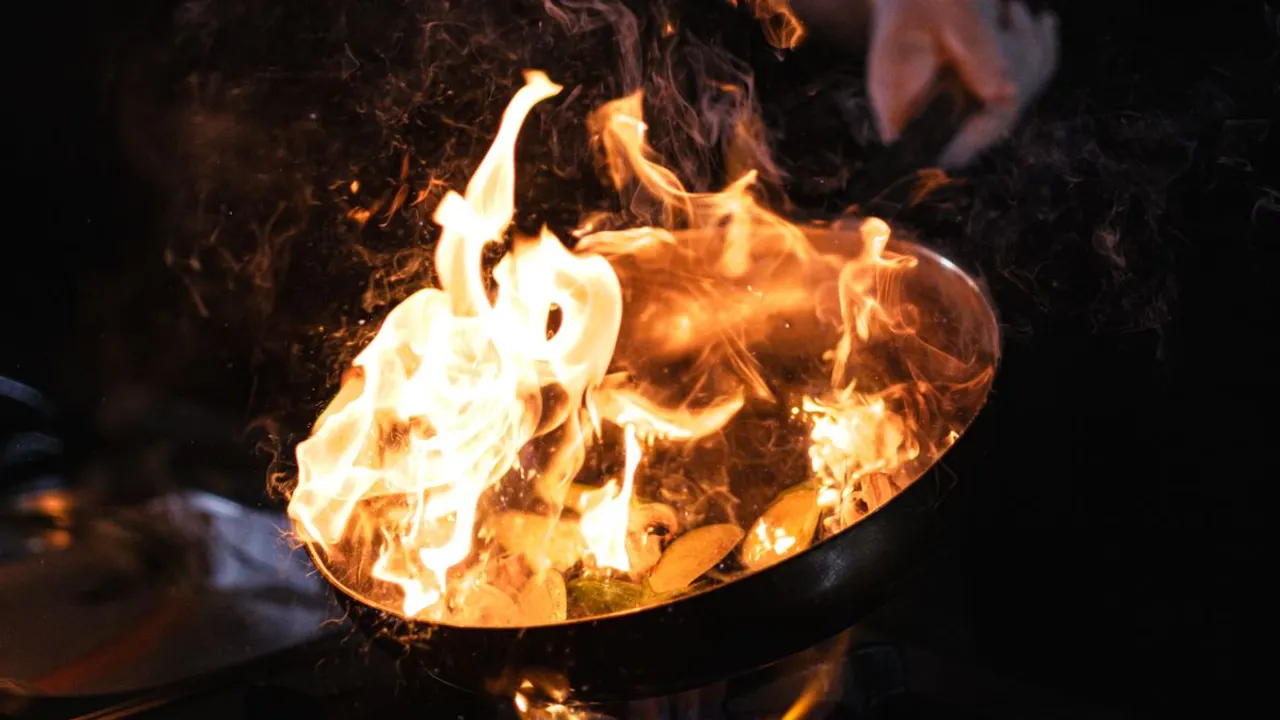
To put out a grease fire: turn off the heat, slide a metal lid or cookie sheet over the pan, and leave it covered until fully cool. Baking soda smothers a small flare-up; a Class K or B extinguisher handles a growing one. Never use water, flour, sugar, baking powder, or a wet towel — each one spreads or feeds burning oil. If the fire moves past the pan, get out and call 911.
A grease fire gives you about 20 seconds of decision time, and the most instinctive response — water — is the one that turns a pan fire into a kitchen fire. Fire departments run demonstrations of this exact mistake because a single cup of water can erupt burning oil into a fireball that reaches the cabinets and ceiling. Here is the response order that works, the science behind the never-do list, and what separates a grease fire from every other fire in your house.
The short version
- Lid, heat off, wait. Smothering with a metal lid or cookie sheet is the fastest safe kill.
- Baking soda works on small flare-ups; it releases CO2 and starves the flame. Salt works too.
- Never water, flour, sugar, baking powder, or wet towels. Water erupts the oil; flour and sugar are fuel; baking powder is not baking soda.
- Never carry the pan. Moving burning oil spreads it — onto you and the floor.
- Fire spreading past the pan means out and 911, with the door closed behind you.
The 20-second response
You win or lose a grease fire in about twenty seconds, so you need the order fixed in your head before it happens. Work through these five steps from the top. Step two is the one that puts the fire out.
- 1. Kill the heat. Turn off the burner. Do not move the pan — burning oil sloshes, and a sloshing pan is how grease fires reach floors, hands, and cabinets.
- 2. Cover it. Slide a metal lid, cookie sheet, or another pan over the top from the side, like closing a book — not dropped from above, which splashes oil. No oxygen, no fire.
- 3. Leave it covered. Hot oil reignites. The lid stays on until the pan is cool enough to touch — that is minutes, not seconds.
- 4. Small flare-up and no lid in reach? Pour baking soda directly on the flames. It takes a lot — a cup, not a sprinkle — which is why the lid is Plan A.
- 5. Growing anyway? Class K or B extinguisher, aimed at the base with a sweeping motion. And if it spreads past the stove: everyone out, door closed, 911.
Never these five — and why each one backfires
Every item below is something people reach for by instinct during a grease fire, and every one of them makes the fire worse. Below is what each one actually does when it hits burning oil.
| Instinct | What actually happens |
|---|---|
| Water | Sinks under the oil, flashes to steam, and erupts burning oil outward — the classic kitchen fireball |
| Flour | Flammable dust — it can ignite and even combust explosively over open flame |
| Sugar | Caramelizes and burns — you are feeding the fire dessert |
| Baking powder | Not baking soda — its ingredients can accelerate the fire instead of smothering it |
| Wet towel | The water in it does what water does; the towel can also catch and drag flames |
The baking soda / baking powder trap: they sit next to each other in the pantry and behave opposite ways over flame. Baking soda (sodium bicarbonate) releases carbon dioxide and smothers. Baking powder contains additional agents that can feed the fire. In a 20-second decision window, that pantry mix-up is a real and documented mistake — one more reason the metal lid is Plan A.
When the grease fire is not in a pan
The lid method above assumes a pan on a burner. Two other grease fires behave differently, and you handle each one its own way. Below are both.
| Where the fire is | What you do | What you must not do |
|---|---|---|
| Inside the oven or broiler | Turn the oven off and keep the door shut. The oven is already a sealed box, so the fire runs out of oxygen on its own. Leave the door closed until everything is cold. | Do not open the door to look. Opening it feeds the fire a fresh supply of air and pushes flame out at your face. |
| A deep fryer or turkey fryer | Turn off the gas or unplug the unit and stand back. If you can do it safely, cover the pot. Outdoors, let it burn down and keep everyone clear. | Do not move the fryer, and never lower frozen or wet food into hot oil. Ice turns to steam instantly and throws burning oil several feet. |
Know the point where you stop fighting
Every instruction on this page has a limit. You stop and leave when any one of these is true:
- The flames reach above the pan to the range hood, the cabinets or the ceiling.
- You have used your extinguisher and the grease fire is still burning.
- You cannot reach the burner controls without putting your arm over flame.
- The room is filling with smoke faster than you can work.
Get everyone out, close the door behind you to starve the fire of air, and call 911 from outside. Do not go back in for anything. A kitchen is replaceable and the fire service would far rather arrive early to a small fire than late to a large one.
If the oil touched you
Cooking oil burns are the most common injury in a grease fire, and hot oil keeps burning your skin after contact because it clings. Treat a burn like this:
- Run cool running water over the burn for a full 20 minutes. Cool, not iced — ice damages the tissue further.
- Take off rings, watches and tight clothing near the burn before it swells. Leave anything stuck to the skin where it is.
- Cover the burn loosely with cling film or a clean non-fluffy cloth.
- Get medical help for any burn bigger than your palm, any burn on the face, hands, feet or joints, and any burn that looks white, leathery or does not hurt.
Butter, oil, toothpaste and ice all belong to old advice that makes burns worse. Cool water is the whole treatment.
Why water makes burning oil explode
Cooking oil ignites around 600°F. Water hitting that oil sinks — water is denser — and instantly superheats past its 212°F boiling point. The flash to steam expands the water roughly 1,700 times in volume in a fraction of a second, and that expansion launches burning oil upward and outward as a spray of flaming droplets. The fireball you see in fire department demos is not the water burning; it is atomized burning oil. This is also why the sink is the most dangerous place to carry a flaming pan.
Grease fire vs. regular fire: why the rules change
You already know how to put out a normal fire, and that knowledge is exactly what puts you in danger here. A grease fire runs on a different fuel, so it answers to a different method. Below is the side-by-side comparison, and the row that matters most is the last one.
| Regular (Class A) fire | Grease (Class K/B) fire | |
|---|---|---|
| Fuel | Wood, paper, fabric | Cooking oil and fat |
| Water? | Works — cools and soaks the fuel | Explosive spread — never |
| Best kill | Water, ABC extinguisher | Smothering: lid, baking soda, Class K/B |
| Residue after | Dry, powdery soot | Oily, sticky soot plus invisible protein film |
That last row matters after the danger passes: grease-fire soot behaves differently from campfire-style soot, and wiping it wet smears it permanently. Our full guide to cleaning up after a grease fire covers the dry-first method.
Which extinguisher actually works
Manufacturers build Class K extinguishers for cooking oils. They lay down a fine mist that turns the oil surface into a soap-like foam (saponification) and seal it from oxygen. Class B covers flammable liquids and works on pan fires. The common ABC dry-chemical extinguisher will usually knock down a small grease fire too — use it before you let a fire grow — but its blast pressure can splash oil if fired too close, and its residue is corrosive on kitchen surfaces. Full breakdown in our guide to what fire extinguisher a kitchen needs.
Fire’s out — kitchen’s a mess?
Extinguisher powder, oily soot, and a smell that reaches every room: that is the standard aftermath of a won grease-fire fight. We handle all three.
Get a Boca Raton estimateAfter it’s out: the residue problem
Winning the fight leaves a specific mess: oily soot on the surfaces near the stove, an invisible protein film that carries the smell far beyond the burn, extinguisher residue if you fired one, and greasy smoke in the HVAC if the fire ran more than a few seconds. The oily film sets into cabinet finishes fast in Florida heat and humidity. For anything beyond a wiped-up flare, professional grease fire cleanup in Boca Raton removes the residue in the right order — dry first, degrease second, deodorize last — before the stains and smell become permanent tenants.
Frequently asked questions
Turn off the burner and slide a metal lid or cookie sheet over the pan from the side. Smothering cuts the oxygen and kills the flame in seconds. Leave the cover on until the pan is fully cool, because hot oil reignites.
Yes, on small flare-ups. Heated baking soda releases carbon dioxide, which starves the flames. It takes a full cup or more, not a sprinkle — and never confuse it with baking powder or flour, both of which make the fire worse.
Water, flour, sugar, baking powder, and wet towels. Water flashes to steam and erupts burning oil outward; flour and sugar are fuels; baking powder contains agents that accelerate flames. Also never carry the burning pan — moving it spreads the oil.
It usually works and beats letting the fire grow, but fire from too close can splash the oil, and ABC residue is corrosive on kitchen surfaces. A Class K or B extinguisher is the right tool for cooking oil. Aim at the base and sweep.
Burning oil deposits an oily soot plus a nearly invisible protein residue on surfaces far from the pan, and the smell lives in that film — not in the air. It persists until you remove the residue with degreasers, and it sets harder the longer it sits.
The bottom line: a grease fire is won or lost in 20 seconds, with a metal lid as the winning move and water as the losing one. Memorize the five never-items, keep baking soda and a Class K or B extinguisher within reach, and once the flames die, respect the residue — it is the part of the fire that stays.