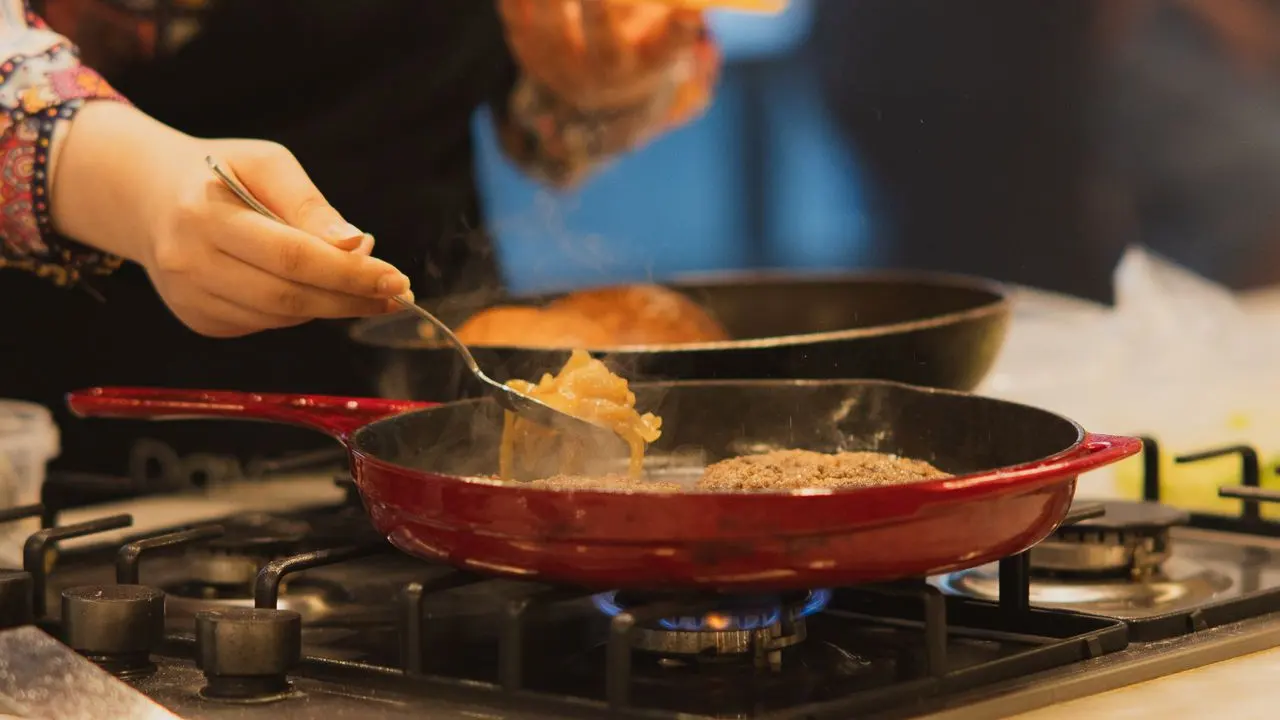
A protein fire happens when meat, fish, eggs or dairy burn, usually food left cooking too long rather than an actual blaze. It produces almost no visible soot but coats the room in a thin, greasy, near-invisible film with a powerful lasting odor. Ordinary cleaners smear it rather than lift it; it needs a degreaser or enzyme cleaner.
The short version
- Protein fires are low flame, high smoke, usually forgotten food rather than a blaze.
- They leave a near-invisible greasy film, not black soot. Nothing looks wrong.
- Household spray cleaners spread the film. Degreasers and enzyme cleaners remove it.
- The odor outlasts the visible damage by months because the residue keeps releasing it.
- Because there is nothing to photograph, it is routinely underestimated on insurance claims.
What counts as a protein fire
The term comes from the restoration industry rather than the fire service, and it describes the residue rather than the flames. A protein fire is what happens when food with a high protein and fat content burns and smoulders. That means meat, poultry, fish, eggs, milk and cheese. A forgotten roast, a Thanksgiving turkey left too long, a chicken reduced to charcoal: those are the everyday versions.
The defining feature of a protein fire is that there is often no real fire at all. A pot of stock left on overnight, a roast forgotten in the oven, bacon abandoned on a hob: low flame, long duration, enormous volumes of smoke. Nothing has to catch alight for a protein fire to coat your entire kitchen. That is exactly why so many people miss what they are dealing with. You go looking for fire damage, and there was never a fire.
Why you cannot see it
Burning wood or paper produces carbon particulate, which is visible black soot that lands on your surfaces and announces itself. Burning protein and fat behaves differently. It vaporizes, travels as an aerosol, and condenses on cooler surfaces as a thin, translucent film. That film is slightly yellow, slightly greasy, and on white paint it is essentially invisible.
Most people discover it in one of two ways. You wipe one section of a cabinet door and the clean patch stands out sharply against everything around it. Or you discover it through time, because the film oxidizes and yellows over the following weeks, so a kitchen that looked untouched in March starts looking faintly jaundiced by May, especially on white cabinetry and ceilings.
How it compares to other smoke
Restoration work divides smoke residue into types because each type needs a different method, and using the wrong method is worse than doing nothing. Most wrong methods drive the residue further into the surface. Below is how the three types differ.
| Dry smoke | Wet smoke | Protein smoke | |
|---|---|---|---|
| Comes from | Fast, hot fires: paper, wood | Slow, smouldering fires: plastics, rubber | Burnt meat, fish, dairy, eggs |
| Looks like | Dry, powdery, visibly black | Sticky, smeary, dark and thick | Almost nothing. A thin amber film. |
| Smell | Moderate, ashy | Strong, acrid | Extremely strong and persistent |
| Removed with | Dry sponge first, then damp clean | Solvent-based cleaners | Degreasers, enzyme cleaners, alkaline agents |
| Main risk | Smearing if you wet it too early | Staining and corrosion | Being missed entirely |
The full three-type breakdown as it applies to cleanup is on our soot and residue cleanup page. If your incident involved burning oil rather than food solids, grease fire cleanup is the closer match.
Why the smell is so much worse
Two things compound in a protein fire. Burning fats and proteins release a different and far more pungent mix of compounds than burning cellulose does. Then the greasy film holds those compounds against the surface instead of letting them disperse.
So you do not have a smell that is fading. You have a residue on every surface in the room that keeps re-releasing odor, and it will keep doing that until someone physically removes it. That is why a protein fire smell routinely outlasts the incident by months, why it gets noticeably worse on warm or humid days, and why deodorizers achieve nothing lasting. We covered what those products can and cannot do in the best smoke odor eliminators.
Why you stop smelling it, and what that costs you
Within a day or two you will mostly stop noticing the smell in your own home. Your sense of smell adapts to a constant background odor and filters it out, which is the same reason you cannot smell your own house when you walk in but a visitor can. Homeowners describe realising the problem only when they are somewhere else, catch an unpleasant smell, and work out that it is coming from their own clothes and hair.
That adaptation costs you money in three ways, so it is worth planning around.
- You under-scope the cleaning. You stop at the rooms you can still smell, which by then is fewer rooms than are actually affected.
- You stop too early. The job feels finished because your nose says so, not because the residue has gone.
- You misjudge how it reads to other people. Guests, tenants and buyers walk in with a fresh nose and get the full strength of it.
The practical workaround is to stop trusting your own nose and use other people instead. Ask someone who has not been in the house to walk through it and tell you where it is strongest, and do that again after cleaning rather than judging your own work.
Where the residue hides
Protein aerosol travels with warm air, so it goes up and it goes everywhere. Below are the places it turns up, which are consistently the places nobody cleans.
- The tops of wall cabinets and the void above them
- Inside light fixtures, where it bakes on and smells worse every time you switch the light on
- Upper walls and ceilings, especially above the cooker
- Inside the range hood and its ducting
- The HVAC return and filter, which then carries the odor into rooms the fire never reached. See HVAC and duct smoke odor.
- Adjoining rooms, carried by air movement, often surprisingly far from your kitchen
Add the appliance itself to that list when the food burned inside one. A microwave or oven is a sealed box that holds the residue and then pushes it back into the room every time its fan runs, so a spotless kitchen can still smell burnt. Homeowners regularly report cleaning everything else successfully and still having to replace the microwave, because the smell never left it.
Why normal cleaning fails, and what works
A general-purpose spray and a cloth will emulsify a greasy protein film just enough to move it around. You lift some of it, you thin the rest across a wider area, and the surface looks clean while the room still smells. Then the thinned film oxidizes and yellows anyway. This is the single most common reason people conclude the smell is “in the walls” when it is still on them. Below is what actually removes protein residue.
- Dedicated degreasers formulated to break down fats rather than lift dust.
- Alkaline, high-pH cleaners, which chemically convert the grease into something water-soluble. That is the same saponification reaction that turns fat into soap, and it lets you rinse the residue off rather than push it around.
- Enzyme cleaners, which digest protein-based soils specifically. Enzymes break down the protein molecules themselves, so they work on the source of the odor rather than only on the film you can feel.
- Rinsing, which is the step most people skip. Degreaser left on a surface is itself a residue.
Work top down every time, and change your cloths far more often than feels necessary. A saturated cloth is just a tool for redistributing the problem.
Clean the air as well as the surfaces
Surface cleaning handles the film. It does not handle what is already airborne, and this is where most DIY attempts on a protein fire quietly fail. You need to know that the two common filters do different jobs.
- A HEPA filter captures particulate. It pulls the fine solid material out of your air, which matters after any fire.
- Activated carbon captures odor. Protein odor travels as gas-phase compounds, and those pass straight through a HEPA filter. Carbon adsorbs them.
So an air purifier with a HEPA filter alone will make your air cleaner and leave it still smelling burnt, which is the exact complaint people bring to us. For a protein fire you want carbon in the filtration, and you want it running while the surface work happens rather than instead of it. Do not skip the range hood filter either. A clean kitchen venting through a loaded grease filter smells burnt every time you turn the fan on.
What you can do yourself
Being honest about the line here saves you money in both directions. Below is a realistic read on where DIY works and where it stops.
| Situation | Realistic call |
|---|---|
| One pan, residue confined to the hob area and nearby splashback | DIY with a proper degreaser. Clean well beyond the area you think it reached. |
| Whole kitchen filmed, cabinets and ceiling involved | Borderline. Doable but slow, and the high surfaces are where it hides. |
| Odor has reached other rooms, or the HVAC ran during the incident | Professional. The duct system needs addressing or it keeps re-seeding the house. |
| Residue on unsealed wood, textiles or inside light fittings | Professional. Porous materials need different handling. |
| Smell persists after a thorough degrease | Sealing stage needed before repainting. |
It helps to know the scale of the gap between the two columns. Homeowners with a burnt-food smell through the house report professional remediation quotes in the region of $10,000 to $15,000, and the reason those numbers exist is everything in the list above: ducts, contents, porous surfaces and sealing, not just wiping the kitchen. Waiting it out is the usual first instinct, and it is the one thing that reliably does not work, because the residue is still there generating the smell.
If your incident was bigger than a pan and you are working out what to do on day one, the first 24 hours after a kitchen fire sets out the order of operations, and kitchen fire cleanup covers how the full job runs.
The insurance problem
This deserves its own heading because it is where a protein fire costs people real money. Every other kind of fire damage photographs well. Protein damage does not. There is no blackened wall to show an adjuster, just a kitchen that looks normal and smells wrong. The wider version of that fight, where insurers reduce smoke-only claims because nothing photographs, is in is smoke damage covered by insurance.
Do not let the absence of flames talk you out of claiming. Households have had insurers cover a protein incident that started with nothing more than a pan of meat boiled dry, because the smoke made the home unusable. The test your insurer applies is the damage, not the drama.
There is a behavioural trap here too, and it is the most common way people lose money on a protein fire. Because nothing looks damaged, you delay reporting the claim, or you decide to clean it yourself and discover weeks later that ordinary cleaners never lifted the film. By then the residue has oxidized, the odor has moved into porous surfaces, and your claim is harder to argue because the scene has been disturbed. Report it early even though it looks like nothing.
Two practical consequences follow. Do not clean before you document the damage. Wiping a test patch to demonstrate the contrast is useful, but cleaning half the kitchen before anyone has assessed it removes your evidence. And describe it accurately in writing, because “protein fire” and “protein residue” are understood terms in restoration and insurance, whereas “the kitchen smells of burnt chicken” invites your insurer to treat the claim as a cleaning matter.
Photograph the wipe-test contrast, the tops of your cabinets, the inside of your light fixtures and the range hood. Those four images tell the story that a wide shot of a tidy kitchen cannot.
Frequently asked questions
A protein fire is a low-flame, high-smoke event caused by burning food with high protein and fat content: meat, poultry, fish, eggs, milk or cheese. Most start when food cooks too long unattended, not in a dramatic blaze. Instead of black soot, protein combustion produces a nearly invisible, greasy, varnish-like film that coats surfaces throughout the room and carries an extremely strong, persistent odor.
Because protein smoke deposits very little carbon. Wood and paper produce visible black particulate; protein and fat produce a vaporized residue that condenses into a thin, translucent, slightly yellow or amber film. On white cabinets and ceilings it is often invisible until you wipe a section and see the contrast against the part you have not cleaned yet. It also tends to yellow over weeks, which is when many people first notice it.
Burning fats and proteins release a different mix of compounds from burning wood or paper, and the greasy film they leave behind holds those compounds against the surface rather than letting them dissipate. Because the residue coats nearly every surface in the room, including places you never clean like the tops of cabinets and inside light fixtures, the odor is continuously re-released. It is why a protein fire smell commonly outlasts the visible damage by months.
A small, contained incident such as a pan of bacon on one hob is realistically a DIY job with a proper degreaser, working top down, changing cloths often, and cleaning well beyond the area you think it reached. What is not a DIY job is a residue that has spread through the whole kitchen and into adjoining rooms, reached the HVAC system, or coated high surfaces you cannot safely reach. Ordinary household spray cleaners tend to emulsify the film and spread it thinner rather than lift it.
No, and it usually makes things worse. Paint applied over a greasy protein film has nothing sound to bond to, so it fails or peels. Worse, the odor compounds sit beneath the new paint layer and keep off-gassing through the porous substrate for months, and in some cases years. Warm, humid weather drives them out fastest, which is why a repainted kitchen smells worst in summer. You must degrease surfaces first, rinse them, then seal with a stain-blocking primer if odor persists, and repaint only after that. Skipping the cleaning stage is the most common and most expensive mistake made after a protein fire.
The bottom line: a protein fire is the one kind of smoke damage that hides. There is nothing black to point at, so it gets underestimated by homeowners and adjusters alike, and it gets “cleaned” with products that spread it. If your kitchen looks fine and smells wrong, stop wiping and start degreasing, and photograph everything before anyone touches it.