Emergency Board-Up in Boca Raton
Once the fire department leaves, an open building is exposed to weather, animals and anyone who walks past. Securing it is the first job, not an afterthought.
Board-up covers broken windows, burnt-through openings and exposed roof areas so the building is closed against weather and entry. It matters in Florida because an afternoon storm into an open structure turns a fire loss into a fire-and-water loss. Insurers generally treat it as a mitigation expense — usually its own line in the claim rather than a deduction from your dwelling limit.
Why this is the first job, not an afterthought
When the fire service hands the property back, the fire has stopped but the loss has not. An open building keeps losing value every hour, in four separate ways.
- Weather. The big one here. Rain into an open structure soaks materials the fire never touched.
- Entry. An unsecured damaged property is an obvious target, and theft after a fire is common enough that insurers ask about it.
- Animals. Open roof and wall cavities in South Florida do not stay empty for long.
- Liability. An open, damaged structure that anyone can walk into is a risk you own.
The insurance point almost nobody explains
People delay calling because they assume board-up costs come out of the money they need for repairs. Usually they do not.
Securing a property after a covered loss is treated as mitigation — work done to prevent further damage — and most homeowners policies handle it as its own line in the claim rather than as a deduction from your dwelling coverage limit. Your policy also places a duty on you to take reasonable steps to prevent further damage, so this is not merely permitted, it is generally expected.
| Emergency board-up | Restoration work | |
|---|---|---|
| When | Immediately, once the property is released | After scoping and adjuster involvement |
| Purpose | Prevent further loss | Repair the loss that occurred |
| Typical claim treatment | Mitigation expense, often a separate line | Against dwelling / contents coverage |
| Typical range | About $500–$2,500 by openings and roof | Scoped per property — see restoration cost |
| Documentation | Photograph openings before and after; keep receipts | Full scope and pre-cleaning photographs |
What gets secured
The aim is a closed building envelope, so the work follows the openings rather than a fixed checklist: broken and burnt-out windows, doors that no longer close or lock, holes in exterior walls, and roof areas opened either by the fire or by firefighters ventilating it. Roof openings are usually covered rather than boarded. Where a property is going to stand empty for a while, it is worth thinking about the whole perimeter rather than only the obvious damage.
The Florida timing problem
Elsewhere, a day or two of exposure is often survivable. Here it frequently is not. Afternoon storms are routine for much of the year, and humidity alone keeps building materials from drying. Wet drywall and insulation in this climate can start growing mould within roughly 24 to 48 hours, which means an unsecured building does not simply stay as damaged as it was — it develops a second, separate problem that was entirely preventable.
That is also why the sequencing matters. Board-up first, then documentation and scoping, then cleaning. Starting the cleanup while the building is still open is doing the same work twice.
What happens after
For the wider running order on day one — utilities, the incident report, where you sleep tonight — see the first 24 hours after a house fire.
Once the building is closed, the loss stops growing and the actual restoration can be scoped properly — residue type, affected rooms, whether the HVAC carried smoke, what can be cleaned and what cannot. That process is set out on our fire damage restoration page, and if the fire started in the kitchen, kitchen fire cleanup covers the greasy-residue side of it.
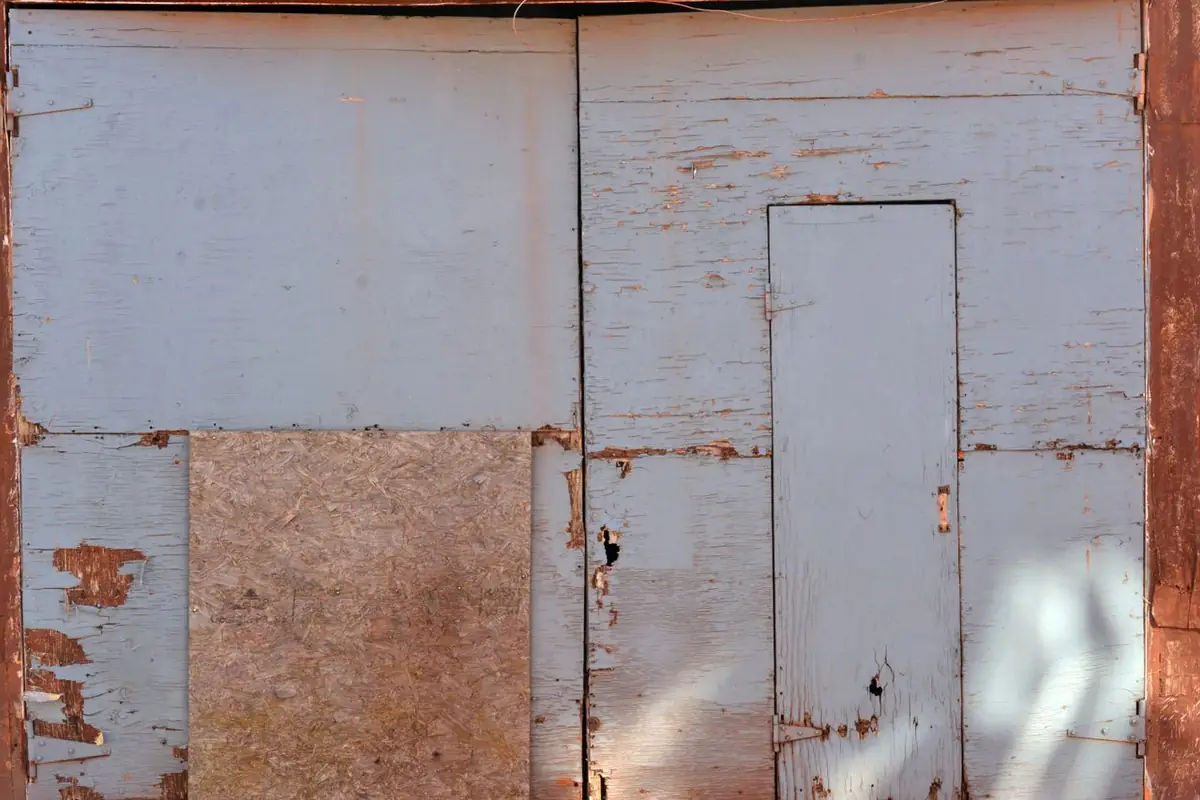 Close the building first
Board-up FAQ
It is the work of closing a damaged building against weather, animals and unauthorised entry — covering broken or burnt-out windows and doors, sealing openings in walls, and tarping or covering exposed roof areas. It is done as soon as the fire service releases the property, before any cleaning or restoration begins, because everything that follows depends on the building being weather-tight.
Generally yes. Most homeowners policies treat securing the property as a reasonable mitigation expense following a covered loss, and it is commonly handled as a separate line in the claim rather than being deducted from your dwelling coverage limit. Coverage still depends on your specific policy and documentation, so keep every receipt and photograph the openings before and after they are secured.
Published ranges generally fall between roughly $500 and $2,500, depending on how many openings there are and whether roof areas need covering as well. A single broken window sits at the bottom of that range; a property with multiple burnt-out openings and roof exposure sits at the top. Because it is usually claimable as mitigation, the practical question is less about price than about doing it quickly.
Because of what the weather does to an open structure. An afternoon thunderstorm into a building with open roof or window areas turns a fire loss into a fire-and-water loss, and in this humidity wet building materials start growing mould in a couple of days. There is also a hurricane-season overlap: a damaged property with unsecured openings is far more vulnerable in a storm than an intact one.
If the building envelope is open at any point, yes. It is not about how dramatic the damage looks, it is about whether weather, animals or people can get in. Policies also place a duty on you to prevent further damage after a loss, and an insurer can question costs that arose because an obvious opening was left unsecured for days.
Property open to the weather?
Securing the building is the first call after the fire department leaves. We can talk you through what it needs.