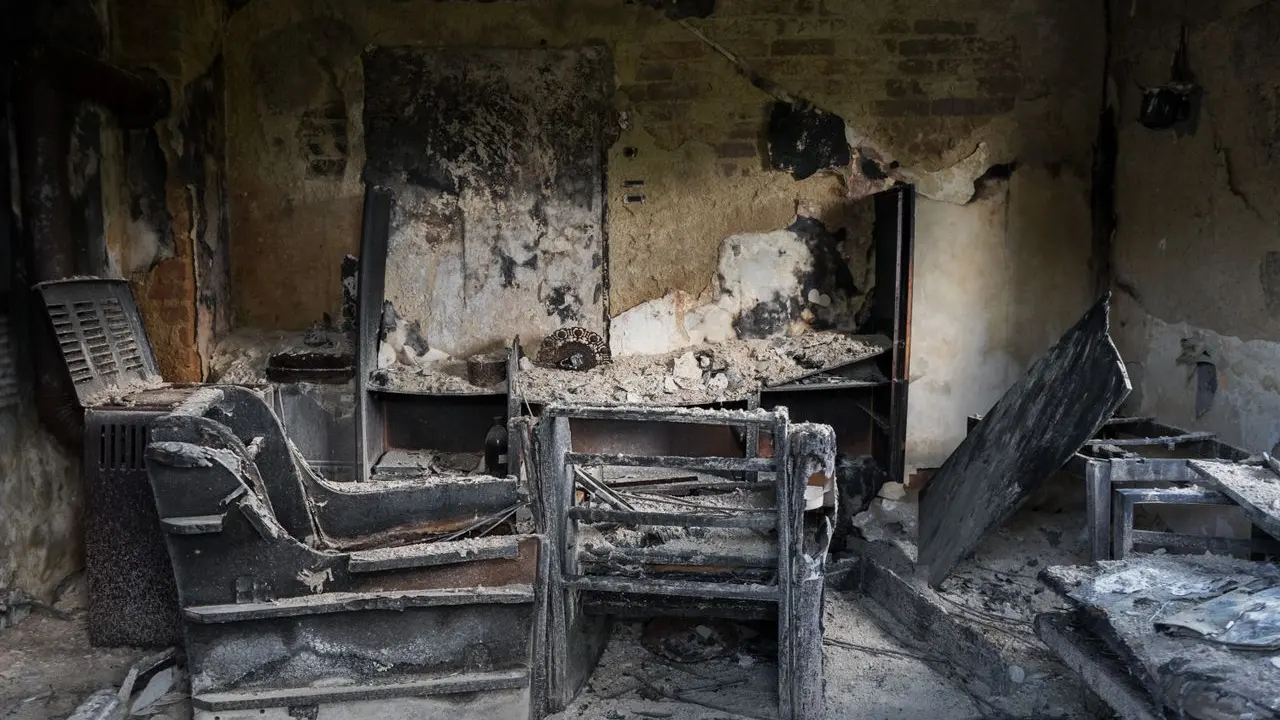
Stay out until the fire service says the building is safe, then call your insurer. Request the fire incident report, get somewhere to stay if the property is not habitable, and have the building secured against weather and entry. Do not restore any utility yourself, and do not start cleaning — cleaning before you document the damage costs you scope on the claim.
The short version
- The fire service releasing the scene means the fire is out — not that the building is habitable.
- Never restore gas, power or water yourself. After an electrical fire the system usually needs an electrician’s certification first.
- A red tag is a legal do-not-enter order, not advice.
- Ask the fire department for the incident report. It is rarely sent to you automatically and your adjuster will want it.
- Document before you clean. Secure the building before you do anything else.
“Released” does not mean safe
When the fire service hands your property back, they are telling you two things: the crew put the fire out, and no emergency remains. They are not telling you the structure is sound, the air is clean, or that you can move back in. Different people make those judgements.
A house fire regularly leaves a building that is structurally fine and still nowhere anyone should sleep. Our guide to whether you can stay in your house after a fire works through how to judge that. Until then, stay out — and when you do go back in, treat it as a short visit with a purpose.
Leave the utilities alone
Firefighters routinely shut off your gas and electricity, and often the water. They leave it that way deliberately, because a house fire damages the systems themselves, not just the things you can see. Heat degrades cable insulation inside walls you cannot inspect. Firefighting water gets into panels and junction boxes. Restore power to a system in that state and you start a second fire hours after the crew left.
After an electrical fire, expect the panel and branch circuits to need certification by a licensed electrician before the utility reconnects you. Book that electrician early, because everything else waits behind it. Our guide to electrical fire soot cleanup explains what that kind of fire leaves on your surfaces.
If the property is red-tagged
A red tag is the building authority declaring your structure unsafe to occupy. Read it as a legal order rather than a strong warning, because that is what it is — entering without authorisation carries consequences on top of the physical risk.
The tag stays until you correct the hazard and an official removes it. Ask the inspector two questions while you have them. First, how do you arrange a supervised entry to collect essentials, which is usually possible even when general access is not. Second, exactly what must you fix before the tag comes off. Write both answers down — you will repeat them to your insurer.
The calls to make, in order
Most day-one advice you will hear is about cleaning. Ignore it for now. Below are the five calls that change your position, in the order they pay off. The first starts a legal clock, so make it today.
Notify your insurer the day of the house fire. In Florida they must acknowledge a claim communication within 7 calendar days and pay or deny within 60 days under Fla. Stat. §627.70131 — and that clock only starts when you tell them. Ask directly whether your policy includes additional living expenses.
Sort accommodation before the evening, not after it. The American Red Cross responds to home fires and is usually the fastest route to shelter, food and clothing the same night.
An open building invites weather, animals and intruders, and your policy expects you to prevent that. You usually claim this separately — see emergency board-up.
The incident report is the official record — date, address, responding department, and a cause determination where the investigator reached one. Your insurer will ask for it, and nobody sends it to you automatically. Request it now and ask how long it takes, because it often runs several days and your adjuster will be waiting on it.
On a mortgaged property the lender commonly receives insurance proceeds jointly with you, and that runs far more smoothly when you have warned them early.
Two mistakes that quietly cost people money
Restoration companies write most of the advice here, so it describes the building. Homeowners who have lived through a house fire describe something else. Two mistakes come up repeatedly, both made by people trying to do the right thing.
Do not empty the refrigerator
The food has spoiled and you know it, so clearing the fridge feels responsible. It is the wrong move. Your contents cover almost certainly pays for spoiled food, but your insurer can only reimburse what somebody inventoried. Bag it and bin it, and the claim goes with it.
One couple who went through two house fires lost that reimbursement entirely for exactly this reason. Photograph the fridge and freezer with the doors open, write a list, and let your adjuster say when to dispose of it.
Some things you should wipe down immediately
Here is the exception to everything above. Smoke residue is acidic, so it does not simply sit on a surface — it etches, and on finished wood, metal and paint that etching turns permanent within days.
The same couple lost a kitchen table this way. A wipe on day one would have kept the damage minimal; instead it needed an extensive restoration. So the two rules sit side by side, and you apply them by asking what the item is for:
| The item | What to do first | Why |
|---|---|---|
| Anything going on the claim — damaged contents, spoiled food, ruined furniture | Photograph it, list it, leave it exactly where it is | An adjuster pays for what you can evidence. Moving or binning it first weakens or kills the claim. |
| Something you intend to keep and it wipes clean — a wood table, a metal appliance, a finished surface | Photograph it, then wipe it the same day | Acidic residue etches. A photograph protects the claim; the wipe protects the object. |
Photograph first in both cases. It takes five seconds, and it lets you act on the second rule without damaging your position on the first.
What to take out, what to leave
Once the fire service clears you for a short entry, move deliberately. Everything you handle spreads soot onto something else, and anything you move before photographing weakens your documentation.
One question sorts most belongings faster than any list: can you wipe this down and wash it easily? If yes, carry it out. If it is porous, fabric-covered or plastic-coated, leave it for the contents cleaners. A stainless steel pan comes with you; an electric toothbrush stays. Below is how that applies to the things people actually reach for.
| Take | Leave | Why |
|---|---|---|
| Identity documents, passports, deeds, policy paperwork | — | Hard to replace and easy to carry |
| Prescription medication | Medication that was exposed to heat or smoke | Heat degrades some drugs. Ask a pharmacist rather than guessing. |
| Essential electronics and chargers, if undamaged | Anything that got wet or hot | Never power up a device that was wet or heat-exposed |
| A few days of clothing from an unaffected room | Clothing from smoke-affected rooms | It needs washing before you wear it — see smoke smell in clothes and fabrics |
| Metal kitchen items a rental will not have — a good pan, a cooking pot | Pillows, bedding, plastic-coated items | Soft goods need proper cleaning and sanitising, and most get replaced. Insurance covers the basics. |
| — | Food, including sealed and refrigerated | Smoke penetrates packaging, and the power has been off — but photograph it before anyone disposes of it |
| — | Anything you have not photographed yet | Moved items are harder to claim for |
Take less than you think you need. Contents cleaners do not arrive on day one and empty your house overnight, whatever the panic feels like, and a second short visit is always possible.
The water nobody warned you about
Almost every guide to the first day skips this, and in Florida it is the thing most likely to turn one loss into two. Putting a house fire out uses a great deal of water, and that water goes into drywall, insulation, cabinetry and subfloor.
In this climate wet materials do not sit quietly. Mould commonly starts within 24 to 48 hours, so you have hours rather than days to get them extracted and dried — a window that lands on the day you are least able to think about it. Standing water, saturated carpet or wet drywall needs dealing with on day one alongside the board-up, not after the smoke damage.
This is why the sequence beats the speed: secure, extract and dry, document, then clean. Cleaning soot off a wall that is still wet inside achieves nothing. Our guide to post-fire water damage and drying covers that work — extraction, opening up saturated assemblies, and drying to a measured standard rather than to the touch.
The things nobody puts on the checklist
Everything above concerns the building and the claim. People who have been through a house fire raise a different set of items, and these matter just as much on day one. Below are the five that come up most.
- Get your pets checked by a vet. Your animals breathed the same smoke you did, and fur hides burns, so a pet that looks fine can carry injuries you cannot see. Birds need attention fastest — their respiratory systems absorb airborne toxins far more efficiently than ours.
- Stop your mail this week. Post piling up at an empty property advertises that nobody lives there, and you will miss insurance correspondence that arrives on paper.
- Write today’s list, then stop. Your recovery runs for months, and treating it as one overwhelming project defeats people. Survivors also report that the first month is the hardest, because the paperwork peaks before the shock wears off.
- When people ask how to help, say gift cards. Your needs change daily, and you cannot predict on Tuesday what you will need on Friday. Donated clothing in the wrong sizes creates a second problem; a card never does.
- Four things run out immediately and nobody thinks of them until they do: clothing, shoes, phone chargers and pet food. The American Red Cross and the Salvation Army cover exactly these gaps, so contact them the same day rather than as a last resort.
The first 24 hours, hour by hour
Everything above collapses into one sequence. Below it is, with the matching mistake beside each step — on day one, knowing what not to do saves you more than knowing what to do.
| When | Do | Don’t |
|---|---|---|
| Immediately | Account for everyone; accept medical checks if offered | Re-enter for belongings |
| First hour | Ask the officer in charge what the building’s status is and whether it is tagged | Assume “released” means habitable |
| Same day | Notify your insurer; request the incident report; arrange somewhere to sleep | Wait until tomorrow — the clock starts at notice |
| Before dark | Get the building secured; address standing water | Leave openings for an overnight storm |
| Day one | Photograph everything room by room, including inside the fridge | Move, tidy, bin or clean anything first |
| Day one | Once photographed, wipe residue off wood and metal you intend to keep | Leave acidic residue sitting for days |
| Next 24–48h | Get wet materials extracted and drying | Let saturated drywall sit in Florida humidity |
If what you had was a contained cooking incident rather than a structure fire, the scale is completely different and most of this page does not apply to you — the first 24 hours after a kitchen fire is the version written for that. Once you are past the first day, our fire damage restoration page sets out the order your recovery runs in, and you will find the claim side on fire insurance claims.
Not sure what needs doing first?
The order matters more than the speed — secure, dry, document, then clean. We can talk you through what your property needs.
Frequently asked questions
Stay out until the fire service says it is safe, then notify your insurer. Those two come before anything else. Then request the fire incident report, arrange somewhere to stay, and get the building secured. Do not start cleaning, and do not restore any utility yourself.
A red tag is the local building authority declaring the structure unsafe to occupy. It is a legal do-not-enter order, not a suggestion, and it stays in force until you correct the hazard and an official removes it. Ask the inspector how to arrange a supervised entry to collect belongings.
No. Firefighters shut off gas and electricity to prevent a second incident, and those services stay off until qualified people restore them. After an electrical fire, a licensed electrician must certify the panel and branch circuits before the utility reconnects you.
It is the official record of what happened, and insurers commonly want it: date, address, responding department, and the cause determination where investigators reached one. Nobody sends it to you automatically, so request it early and avoid a delay when your adjuster asks.
Not on day one. Cleaning before you document destroys the evidence your claim depends on. Soot is also acidic and irritates skin and airways. The exception is emergency mitigation your policy expects — securing the building and stopping ongoing water. Photograph that work and keep the receipts.
If the property is not habitable, most homeowners and renters policies include additional living expenses cover, often called loss of use, which pays for temporary accommodation. Contact your insurer straight away and keep every receipt. For the same night, the American Red Cross is usually the fastest help.
The bottom line: day one is about three things — don’t get hurt, don’t lose evidence, and stop the loss growing. Everything else goes better if you get those right.