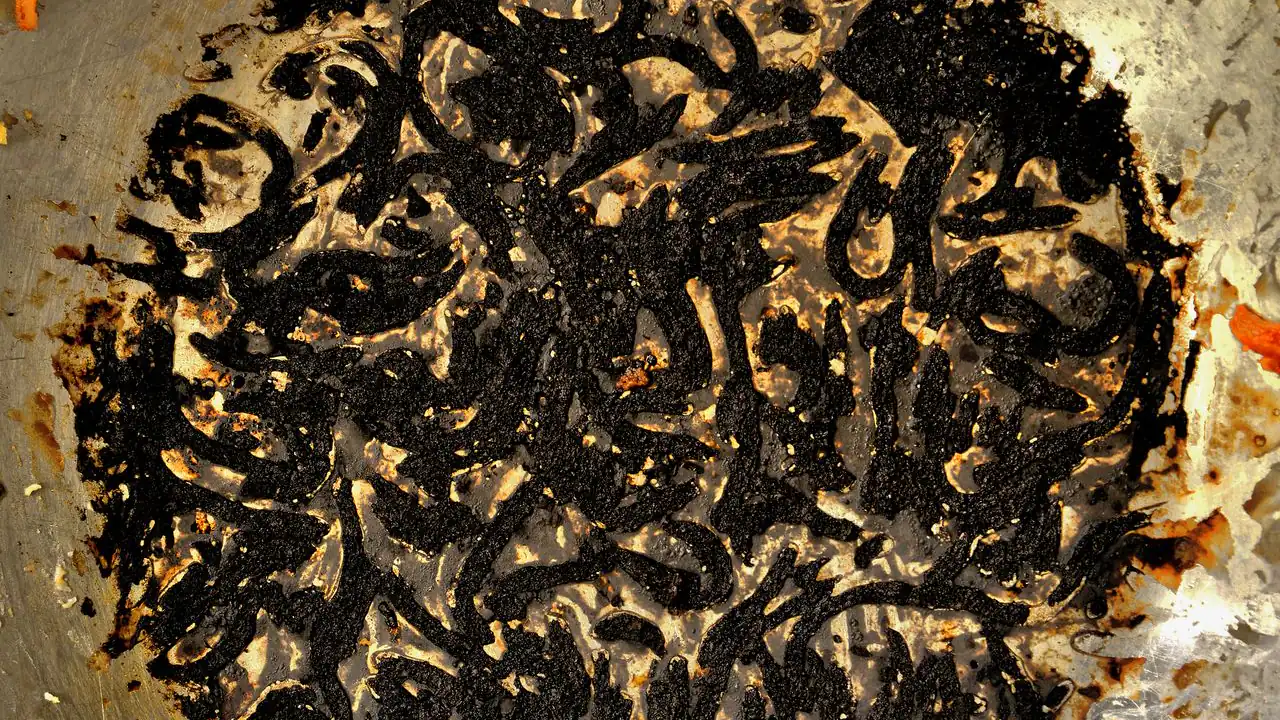
Get the burnt item outside immediately, ventilate through open windows rather than exhaust fans, and switch the air conditioning off so it stops circulating the smell. Then wash the surfaces near the burn with a degreaser, because if you can still smell it there is still residue producing it. Bowls of vinegar or activated charcoal help the air while you do that. Burnt toast clears in hours; scorched protein like egg or milk can take several days.
The short version
- The burnt item keeps releasing odor while it sits in the kitchen bin, so take it outside first.
- Ventilate through windows. Exhaust fans alone depressurize the house and move surprisingly little air.
- Turn the air conditioning off. Left running, it distributes the smell into rooms that were never affected.
- Burnt protein leaves an oily residue and lasts days; burnt toast is gone in hours.
- Simmering citrus masks the burnt smell. Washing the surfaces is what removes it.
- If you can still smell it, there is still residue. Ventilation moves the smell; only cleaning ends it.
The first thirty minutes
What you do immediately matters more than anything you do later, because the pan is still producing the smell. Most people reach this page the same way: you left something on the heat, or fell asleep while a pot boiled, and walked into a kitchen that smells nothing like food. Work in this order:
Straight to the outdoor bin. It keeps emitting for hours.
Cross-ventilation moves far more air than one window or a range hood.
Otherwise it delivers kitchen smoke to every bedroom in the house.
Smoke settles fastest within a few feet: hob surround, backsplash, cabinet fronts.
One warning is worth repeating. Do not carry a smoking pan to the sink and run cold water into it. The water flashes to steam, and the steam carries burnt particulate outward far more efficiently than the pan was managing alone. Let the pan cool, or take it outside as it is.
Why what burned decides how long it lasts
This is the part almost every guide skips, and it is why two people get different results from the same advice. What burned determines what residue it left, and the residue determines how long you live with it. Here is what to expect:
| What burned | Why it smells the way it does | Typical clearing time |
|---|---|---|
| Bread, popcorn, dry carbohydrates | Mostly dry carbon particulate, little oily residue | 2–6 hours with good ventilation |
| Rice, pasta, vegetables | Some starch residue, and steam that carries odor further through the house | Up to about a day |
| Egg, milk, cheese, meat (protein) | A fine, oily, near-invisible film that keeps releasing odor after the smoke clears | 3–7 days; surfaces must be washed |
| Oil or grease | Greasy aerosol travels widely and settles sticky; highest fire risk too | Several days; degreasing required |
| Plastic, rubber, electrical insulation | Chemically different, sharply acrid, bonds strongly to surfaces | Weeks if surfaces are not cleaned. Treat the cause as urgent. |
That ranking is not kitchen folklore. The American Lung Association notes that cooking temperature and cooking time both track with how much particulate a dish puts into the air, and that high-fat meat produces significantly more than lean.
Scorched protein is the case people underestimate. The visible smoke is modest and there is barely any black soot, yet the smell is powerful and persistent, because it deposits a thin varnish rather than dry ash. If burnt egg or milk is your situation, wash the hard surfaces with a degreaser rather than waiting the burnt smell out.
The air-conditioning mistake
A central air system does not know the difference between air and smoke. Left running while the kitchen is full of burnt smell, the system pulls that air in through the return and pushes it out through every supply vent in the house, leaving odor compounds on the filter and inside the ductwork on the way. Rooms that had nothing to do with the incident start to smell, which is why people describe a single burnt pan as making the whole house stink. The system also becomes a reservoir, breathing a little back out every time it cycles on. That is the usual answer to “why does it keep coming back after I cleaned everything?”
So switch the system off while you ventilate, then change the filter before you turn it back on. A filter is the cheapest diagnostic you have. If the burnt smell still returns through the vents with a fresh filter in, the duct surfaces are holding it, and that is a smoke in the ductwork problem rather than a kitchen one.
In South Florida this creates a real tension in summer, because you cannot leave windows open for eight hours in August without the humidity becoming its own problem. The compromise is a hard ventilation burst of thirty to sixty minutes, windows wide and system off, then close up, run the system with a fresh filter, and let absorbers work overnight.
Actually removing the smell
One principle decides whether the burnt smell clears this week or hangs around for a month:
If you can still smell it, there is still residue. Burnt smell is not free floating. It comes from smoke that condensed onto your surfaces and is still evaporating off them. Ventilation and absorbers move the smell around; only cleaning removes the source. That is why people who ventilate for four days still smell it, and why an hour with a degreaser often ends it.
Absorbers, and what they are good at
Activated charcoal is the most effective household option, and it is the same material used in air-purifier carbon filters. White vinegar in shallow bowls works reasonably well for almost nothing. Baking soda is the weakest for airborne odor, though it is useful on carpet, vacuumed off the next day. All three work on air rather than residue, over hours rather than minutes, so put them where the air moves. Our guide to smoke odor eliminators covers the commercial products in the same honest terms.
Surfaces, which is where the real gains are
For anything greasier than toast, wiping matters more than ventilating. Residue settles heaviest within a few feet of the source and on the surfaces above it, because the plume rises: the backsplash, the fronts and undersides of wall cabinets, the range hood, and the ceiling over the hob. Use a degreaser rather than a general spray, and work top-down.
Then deal with textiles, where lingering odor hides once the hard surfaces are done. Anything washable goes through the machine: tea towels, oven gloves, curtains, cushion covers. Fabric holds odor far longer than paint does, and one unwashed curtain keeps a kitchen smelling faintly burnt for a week.
Before you buy an ozone generator
This is where a lot of people give up and order one. The pattern repeats in every forum thread on burnt smells: ventilate for two days, try vinegar, still smell it, buy an ozone generator and run it in the apartment you are living in. Know two things first. Ozone is a respiratory irritant and the EPA does not recommend running these machines in occupied spaces. And ozone oxidises odor compounds in the air, so it does nothing about the residue still producing them. Read our honest assessment of ozone generators before you buy.
Is it clearing on schedule?
The usual mistake is deciding at hour six that nothing is working and reaching for an aerosol. Use the clock to tell you which problem you still have:
| Time since the burn | What should be happening | If it isn’t |
|---|---|---|
| First few hours | Visible smoke gone, sharpest edge off the smell | Air is not moving. Check the fan faces outward, not in |
| 24 hours | A dry burn should be essentially gone | The source is still indoors, or the air conditioning spread it |
| 2–3 days | A protein or grease burn fades once surfaces are washed | Suspect a greasy film on cabinet fronts or the range hood |
| 1 week | Even a greasy burn should be resolved | Check the HVAC filter and soft furnishings; both re-release odor |
| 2 weeks or more | Nothing. You should not still be here | The odor is held in the materials now, not the air |
If what burned was meat, fish, eggs or dairy, that is a protein fire, and it leaves a near-invisible film that ordinary cleaners spread rather than lift.
Four things that make it worse
Some of the standard advice sets you back, and three of these four are things people try in the first hour. Here is what to avoid:
- Running water into a hot burnt pan. The steam spreads the particulate through the kitchen almost instantly.
- Lighting scented candles to cover the smell. Understandable, and it adds a second problem, because heavy candle use deposits soot and is a known cause of dark staining on walls and ceilings.
- Using the oven self-clean cycle to fix the smell. It incinerates residue at very high heat and produces a great deal of smoke of its own, which makes the next few hours worse.
- Leaving the burnt item in the kitchen bin. It is still the source. Outside, now.
Burnt popcorn: the microwave is the reason it won't clear
Burnt popcorn behaves unlike a scorched pan in one important way. You carry a burnt pan outside. The microwave stays on the counter with the residue sealed inside it, which makes the appliance an odor reservoir. The room airs out, then someone opens the door or runs the over-range fan and re-doses the kitchen. People read that as “the smell won't go away” when a single box keeps releasing it.
So empty the reservoir rather than airing the room again, and remember the two places people miss: the roof of the cavity and the inside lip of the door seal. If your microwave sits over the range, the hood filters underneath it caught the same smoke, and a clean microwave venting through a loaded filter still smells burnt whenever the fan runs. The full step-by-step, the timelines by severity and what to do if it was an actual microwave fire are all in burnt microwave smell through the whole house.
When a burnt smell is worth worrying about
A one-off burnt dinner is a nuisance rather than a hazard for most people, but it is worth being straightforward about what is in that air. The American Lung Association describes the harm from cooking particulate as fine particles reaching deep into the lungs, where they irritate and corrode the alveolar wall, the air sacs that pass oxygen into your blood. Burning food sits at the extreme end of that scale, and the ALA names one compound worth knowing about: formaldehyde, a carcinogen, is frequently a byproduct of broiling or overcooking food. That is not a reason to panic over one ruined dinner. It is a good reason to ventilate hard instead of sitting in it. Three situations change the calculation:
- Someone in the house is vulnerable. Fine particulate and the irritants in overheated fat are what make burnt cooking sting your eyes and catch in your throat. If someone has asthma or COPD, or there is an infant at home, move them to another room and ventilate hard.
- The smell is sharp, acrid, plastic or fishy. That profile is not burnt food. It points to overheating electrical insulation and needs a different response: cut power to the circuit and investigate. If you cannot trace a burnt smell to something you cooked, our guide on smoke coming from a stove or oven covers how to tell appliance burn-off from a wiring problem.
- You cook on gas and someone feels unwell. Carbon monoxide is invisible, odorless and non-irritating, so it is the one thing your nose cannot warn you about. Gas ovens, especially older ones, are more likely to produce it, and the symptoms read like something else entirely: headache, dizziness, weakness, nausea, chest pain, confusion. If people feel better once they leave the house, treat that as the alarm. The ALA recommends a carbon monoxide detector on every level of the home, mounted at least 15 feet from a gas stove so normal cooking does not set it off.
When it is more than a smell
Occasionally burnt dinner leaves more behind than odor: a scorched cabinet face, a yellowed patch of ceiling above the hob, or a greasy film that smears rather than lifts. That is deposited residue, and ventilation does nothing for it.
If there were flames in the pan or an appliance caught, the cleanup is a different job and the sequence matters. Our guides on cleaning up after a grease fire and the first 24 hours after a kitchen fire cover that ground.
Frequently asked questions
It depends entirely on what burned. Burnt toast or popcorn usually clears within two to six hours with good ventilation. Burnt rice or vegetables take a day or so. Scorched protein such as egg, milk, cheese or meat commonly lingers three to seven days because it leaves an oily residue that keeps releasing odor. Burnt plastic can persist for weeks and needs surfaces washed, not just air moved.
For a healthy adult, a one-off burnt food smell is unpleasant rather than harmful. The smoke does contain fine particulate and irritants such as acrolein from overheated fats, which can trigger coughing, watering eyes and asthma symptoms, so it is worth ventilating properly and moving anyone with a respiratory condition, plus infants, out of the room. Burning plastic or an electrical smell is a genuinely different matter, and it is urgent.
Almost always the air conditioning. A central system pulls the smoke-laden air in, distributes it through every room, and loads the odor into the filter and the duct surfaces, which then release it again each time the system runs. Change the filter, and if the smell still returns through the vents after that, the ductwork itself is holding it.
No, it covers it. Simmering citrus peel, cinnamon or vinegar puts a stronger, more pleasant smell into the air, and while vinegar steam does neutralise some odor compounds, the pleasant-scent versions are pure masking. As the scent fades the burnt smell is still there, because nothing removed the residue producing it. Use it for guests arriving in an hour, not as your actual plan.
Not as a fix for household smell. Self-clean runs the oven up to around 900°F and incinerates residue, which produces a large amount of smoke and a strong odor of its own, so you will make the house smell worse for several hours. Scrape and wash the oven interior by hand instead, and save self-clean for a day when you can ventilate heavily and be out of the house.
Move the source outside first, because it keeps emitting while it sits in the kitchen bin. Then create cross-ventilation with windows on opposite sides and a box fan pointed outward, switch the HVAC off so it is not spreading the smoke, and wipe down the hard surfaces nearest the burn with a degreasing cleaner. Absorbers such as activated charcoal or white vinegar then mop up the remainder over the following day.